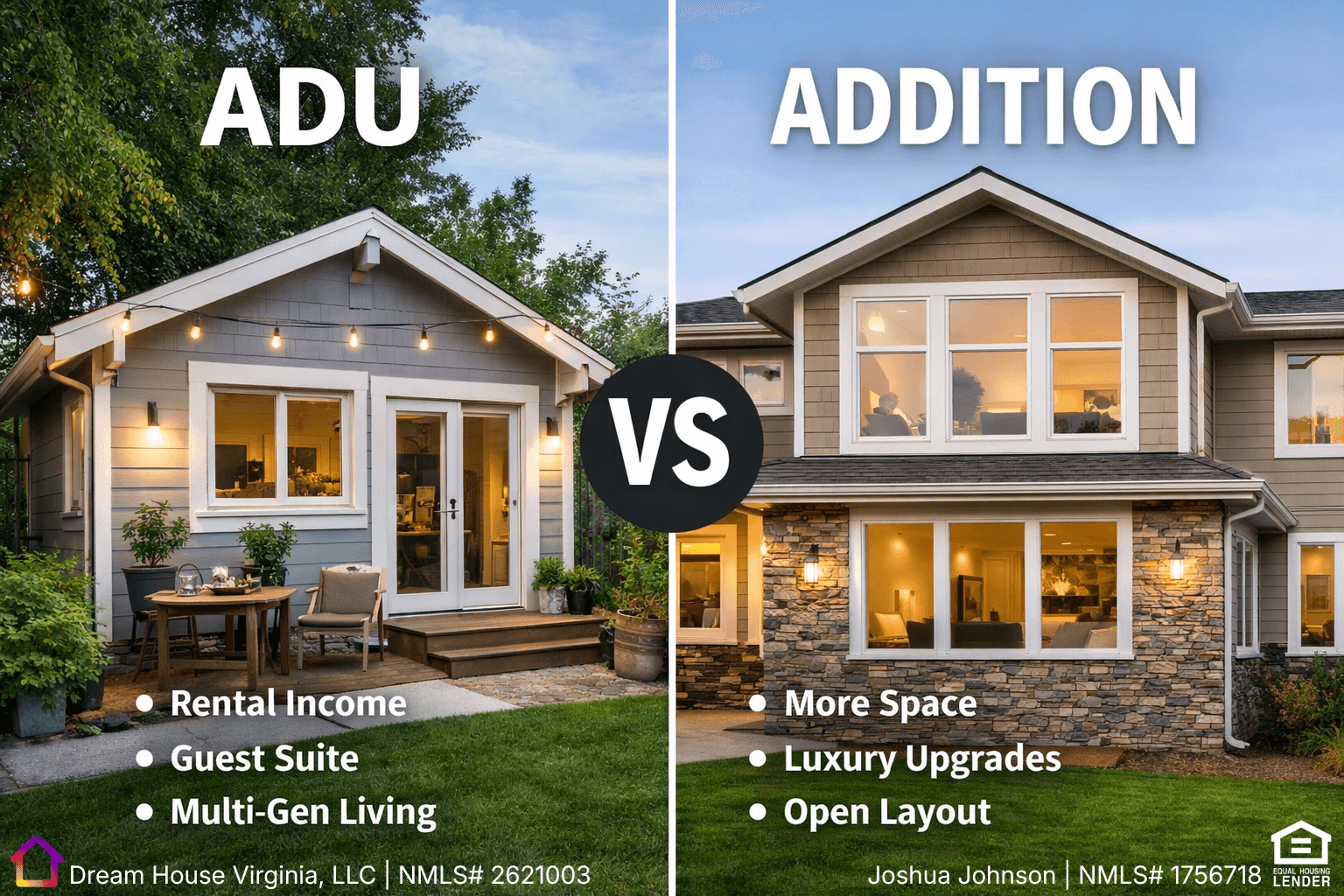
If you’re a homeowner in Richmond, Chesterfield, or Henrico and you’re itching for more space, you’ve got two popular “make-the-house-bigger-without-moving” options:
Build an ADU (Accessory Dwelling Unit), like a backyard cottage, garage apartment, or finished basement unit, or
Build a traditional home addition, expanding the main house with more square footage.
Both can be great moves. Both can also become expensive puzzles if you don’t plan around zoning, valuation, and financing. As an RVA mortgage broker, we get this question a lot: Which one helps resale the most, and which gives me the most flexibility?
Let’s break it down in plain English with a few “real life” scenarios.
An ADU is a secondary living space on the same property as a primary home. It typically has:
A sleeping area
A bathroom
A kitchen or kitchenette
Separate entry (often)
Its own “living as a unit” feel
Common ADU types:
Detached backyard cottage
Garage conversion with living space above or within
Basement or attached suite that functions like a small apartment
A traditional addition is an expansion that becomes part of the main home, like:
A larger kitchen and family room
A new primary suite
Added bedrooms and bathrooms
Second-story expansion
Sunroom or conditioned living space that blends into the home
Here’s the core trade-off:
They can create:
Rental income potential
Multi-generational living (parents, adult kids)
Guest space without sharing walls
Home office/studio with separation
A long-term “Plan B” if life changes
They improve:
The home’s layout and livability
Finished square footage buyers instantly understand
Lifestyle upgrades (bigger kitchen, better primary suite)
“This feels like a nicer house,” which can matter a lot in resale
If an ADU is a Swiss Army knife, an addition is a chef’s knife: fewer tricks, but it slices through everyday life beautifully.
Why? Buyers and appraisers are typically more comfortable valuing added finished square footage in the main home. Comparable sales are easier to find because so many homes have additions or expanded living areas.
Resale strong points:
More bedrooms/baths in the main house
Bigger kitchen and entertaining space
Improved “functional layout”
Broader buyer pool
An ADU can be a huge value add in the right neighborhood, but its value is sometimes less “plug-and-play” because:
Comps with ADUs may be limited
Utility setups and permits matter
Buyer demand can vary by area
Some buyers don’t want a landlord vibe
Resale strong points:
Buyers who want multi-gen options
Buyers who want a home office detached from the house
Buyers who want potential rental income
Reality check: ADUs can add value, but the value isn’t always dollar-for-dollar with build cost. That doesn’t mean they’re a bad investment. It means the plan should match your goals, timeline, and neighborhood.
An ADU can morph with your life:
Today: home office
Next year: aging parent suite
Later: long-term rental
Eventually: guest cottage for visiting family
It’s space that can serve multiple chapters.
Additions are typically best if your goal is:
“We need more space for our family and we want it connected”
“We want a bigger primary suite and better daily living”
“We want to avoid managing a separate unit”
Additions are less “switchable” than ADUs, but they often make the main home feel significantly better every single day.
Before you choose ADU or addition, verify these early:
Local zoning rules (ADU allowance, size limits, setbacks, parking requirements)
Utility capacity (sewer/septic considerations, water, power)
Access/parking (driveway, street parking restrictions)
HOA rules (if applicable)
Lot coverage and easements
Even if you’re excited, treat this like a pre-flight checklist. It’s much cheaper to learn you can’t build the thing before you’ve bought the plans.
Financing is where the strategy gets real. The best route depends on your equity, credit profile, budget, and whether you’re building before or after you move.
Common routes homeowners consider:
Uses available equity to fund the project
Can be straightforward, but you’ll want to compare the new rate vs. your current one
Keeps your first mortgage intact
Adds a second payment tied to project costs
Often appealing when you like your current first mortgage rate
Can be useful when the scope includes major improvements
Usually requires documentation and contractor details
More structured process
Draw schedules, inspections, contractor requirements
Important note: ADUs can be trickier than additions in some cases, not because they’re “bad,” but because the structure is more like adding a second dwelling unit than expanding a single-family layout. That’s why planning the path early matters.
If you want help sorting the options, talking with a mortgage broker can save you from chasing the wrong loan type for weeks.
A separate living space for family or guests
Rental income potential (now or later)
A home office or studio with separation
Maximum “use-case flexibility” over time
Better daily living space connected to the home
A more predictable resale story tied to square footage
A layout upgrade (kitchen, primary suite, family room)
Less complexity around separate-unit considerations
Flexibility and optional income: lean ADU
Seamless living and broad resale appeal: lean addition
Whether it’s an ADU or addition, ask these first:
What does zoning allow for my address?
Will utilities support the plan (water/sewer/power)?
Are there parking or access requirements?
How will the project be valued when complete?
What financing path fits my timeline and budget?
Do I plan to sell in 2 years, 5 years, or 10+ years?
It often can, but the amount depends on neighborhood demand, permitted status, quality of build, and how many comparable homes with ADUs exist nearby.
Additions are usually more straightforward to value because appraisers can find more comparable homes with similar finished square footage.
Sometimes, depending on the loan program, documentation, and property setup.
The details matter, so it’s worth reviewing early with an mortgage broker who specializes in Richmond.
It depends on the build type and site conditions. ADUs can involve extra utility work and standalone construction. Additions can require major structural work and tie-ins. The “cheaper” one is the one that fits your lot and goals without surprises.
If you’re considering an ADU or addition in the Richmond area, we can help you map the financing path and avoid dead ends.
Message us with:
The address (or neighborhood)
Your rough budget range
Your goal (space, multi-gen living, rental potential, resale timeline)
We’ll help you compare options like a local guide, not a generic calculator. If you’re looking for a mortgage broker near you who can talk strategy in plain English, we’re here.
Dream House Virginia, LLC
Local mortgage guidance for Richmond, Henrico, and Chesterfield homeowners.
