June 26, 2026 | 5 min read
For buyers, Realtors, and anyone trying to make sense of today’s housing market, affordability has felt like a locked door with three different keys: home prices, mortgage rates, and inventory.
The 21st Century ROAD to Housing Act does not control mortgage rates. It does not instantly lower asking prices. And it will not magically turn every tight market into a buyer’s market overnight.
But it does aim at one of the biggest reasons home prices have stayed so stubborn: not enough housing supply.
That is the part worth watching closely. When more homes can be built, financed, repaired, converted, or brought back into usable inventory, buyers get more options. When buyers have more options, competition can cool. And when competition cools, the market has a better chance of becoming healthier for both borrowers and Realtors.
One of the clearest supply-focused pieces of the bill is the Build Now Act section, which ties some Community Development Block Grant funding to housing production.
In plain English: communities that move faster on homebuilding could be eligible for bonuses, while lagging communities could see small funding reductions.
That matters because a lot of housing affordability problems are local. Federal policy can encourage more supply, but zoning, permitting, inspections, and approval timelines often happen city by city and county by county. This provision tries to nudge local governments away from “we support affordable housing in theory” and toward measurable housing production.
How this could help costs: if more communities are pushed to approve and support more housing, especially in areas where demand is high, that can gradually reduce the bidding pressure that keeps prices elevated.
Why Realtors should care: more production can mean more listings, more realistic buyer conversations, and less pressure to treat every decent home like the last helicopter out of town.
The bill also includes a Housing Supply Frameworks section, directing HUD to publish guidelines and best-practice frameworks for state and local zoning and land-use policies.
That may sound wonky, but it matters. Local rules can quietly add years, dollars, and friction to housing development. Lot size rules, parking requirements, slow review processes, density limits, and outdated approval systems can all make it harder to build homes where people actually want to live.
The bill does not simply say “build more.” It tries to create a federal playbook for local governments to modernize the rules that shape what can be built.
How this could help costs: when communities streamline approval processes, allow more flexible housing types, or reduce unnecessary delays, builders may be able to deliver more homes at lower cost. That can help ease price pressure over time.
Why borrowers should care: this is the kind of reform that may not show up in tomorrow’s listing alerts, but it can change the future inventory pipeline.
The ADU-related piece is not just “ADUs are nice.” The actual mechanism is more specific.
Under the Accelerating Home Building Act section, the bill provides grants to local governments and tribes to select and implement pre-reviewed housing designs, including accessory dwelling units, duplexes, and townhomes.
That is important because pre-reviewed designs can reduce one of the hidden enemies of affordability: repeating the same approval process from scratch over and over again.
If a locality already has vetted plans for an ADU, duplex, or townhouse, a homeowner or small builder may have a clearer path to approval. Fewer design delays. Fewer review bottlenecks. Less uncertainty. Less “please resubmit the thing we already looked at wearing a slightly different hat.”
How this could help costs: faster and more predictable approvals can reduce soft costs, carrying costs, and delays. That can make smaller-scale housing additions more realistic.
Why Realtors should care: this could make property flexibility more valuable. Buyers may increasingly ask whether a lot can support an ADU, whether local rules allow it, and whether pre-approved designs exist in that jurisdiction.
The bill also targets manufactured housing and property improvement financing through the Property Improvement and Manufactured Housing Loan Modernization Act section.
This section does three practical things:
That is much more concrete than “supporting alternative housing.” It means the bill is trying to make financing tools better match the kinds of lower-cost or flexible housing options people may actually use.
How this could help costs: manufactured homes and ADUs can create lower-cost housing options, but only if financing is workable. Better loan limits and broader eligible uses can help more buyers and homeowners access those options.
Why borrowers should care: this could eventually open more pathways for buyers who do not fit neatly into the traditional detached single-family home box.
The bill’s Housing Supply Expansion Act section eliminates the permanent chassis requirement for manufactured homes.
That sounds technical because it is. But it could matter a lot.
Under older rules, manufactured housing has been tied to requirements that can limit design flexibility. Removing the permanent chassis requirement could allow factory-built homes to be designed in ways that look and function more like other site-built or modular housing options.
The bill also establishes HUD as the primary authority on energy efficiency standards for manufactured homes and requires HUD to create minimum energy efficiency standards.
How this could help costs: modernized rules may allow more efficient factory-built housing designs, potentially lowering construction costs and expanding the types of homes that can be produced. More efficient production can mean more attainable housing options.
Why Realtors should care: manufactured housing may become a more serious part of the affordability conversation, especially for buyers priced out of traditional inventory.
The Modular Housing Production Act section directs HUD to review FHA construction financing programs, identify barriers for modular housing developers, and begin related rulemaking.
It also allows HUD to study the usefulness of a standardized code for modular homes.
That matters because modular housing can be faster and more predictable than traditional construction, but financing and regulatory friction can keep it from scaling. The bill tells HUD to look directly at those barriers instead of letting them sit in the basement with the old paint cans.
How this could help costs: if modular housing becomes easier to finance and approve, builders may be able to deliver homes faster and with more predictable costs.
Why borrowers should care: more modular housing could eventually mean more new construction options at price points that are harder to reach with traditional building methods.
A home that costs less does not automatically help if the mortgage market does not work well for smaller loans.
That is why the bill includes FHA Small-Dollar Mortgages, allowing HUD to establish a pilot program to expand access to FHA-backed mortgages under $100,000. That pilot sunsets after four years.
It also includes sections directing the CFPB to study small-dollar loan originator compensation and evaluate how current points and fees thresholds affect small-dollar mortgage lending.
This matters because smaller loans can be harder to originate profitably under today’s cost structure. If lenders are discouraged from making small loans, lower-priced homes become harder to finance, especially in rural areas or lower-cost markets.
How this could help costs: improving access to small-dollar mortgages could make lower-priced homes more financeable, which helps buyers who are not shopping in higher price brackets.
Why Realtors should care: if smaller loans become easier to originate, more buyers may be able to compete for affordable homes that might otherwise be cash-heavy or investor-heavy transactions.
The bill’s RESIDE Act section creates a pilot grant program to help local governments convert vacant commercial or industrial buildings into affordable housing.
The program prioritizes economically distressed areas and Opportunity Zones.
This is important because some communities have underused buildings sitting idle while residents struggle to find housing. Converting existing structures can sometimes be faster or more practical than building entirely from scratch, depending on the property, location, condition, and local rules.
How this could help costs: adaptive reuse can add housing supply without needing every unit to start as raw land development. More usable housing can help ease inventory pressure.
Why borrowers should care: this could eventually create more housing options in areas where new construction land is limited or expensive.
The bill also changes how existing federal community development dollars can be used.
Under the Addition of Affordable Housing Construction as an Eligible Activity section, Community Development Block Grant funding can be used for the construction of new affordable housing.
That is a meaningful shift because CDBG is already a major tool for local governments. Allowing those funds to support new affordable housing construction gives communities another way to add supply, rather than only addressing pieces around the edges.
How this could help costs: when local governments can use existing federal funding streams to directly support affordable housing construction, it can help fill financing gaps that often stop projects from moving forward.
Why Realtors should care: more affordable housing production can create a healthier ladder of housing options, which matters for first-time buyers, move-up buyers, renters, and sellers alike.
The bill’s Homes Are for People, Not Corporations section restricts large institutional investors that directly or indirectly own at least 350 single-family homes from purchasing additional single-family homes.
The bill includes exceptions, including for certain build-to-rent activity, and it creates a renter outreach resource at HUD for tenants in homes owned by large institutional investors.
This is aimed at markets where everyday buyers feel like they are competing against entities with deeper pockets, faster cash, and very different return calculations.
How this could help costs: limiting additional purchases by large institutional investors may reduce competition for some single-family homes, especially in markets where investor activity has been concentrated.
Why borrowers should care: the goal is to make more homes available to people who want to live in them, not just entities building a portfolio.
The bill also includes an Appraisal Modernization Act section.
This requires USDA, VA, FHA, and the Federal Housing Finance Agency to implement requirements for lenders of federally backed mortgages to have review and resolution procedures for reconsiderations of value or second appraisals requested by consumers.
That matters because valuation issues can make or break transactions. A low appraisal can force renegotiation, require extra cash, delay closing, or sink the deal entirely.
How this could help costs: this does not lower home prices directly, but it may create a clearer process when a borrower believes the valuation missed important information. Better process can reduce friction and improve confidence in the transaction.
Why Realtors should care: clearer appraisal review procedures can help agents and borrowers understand what options exist when the value does not appear to reflect the property or market data.
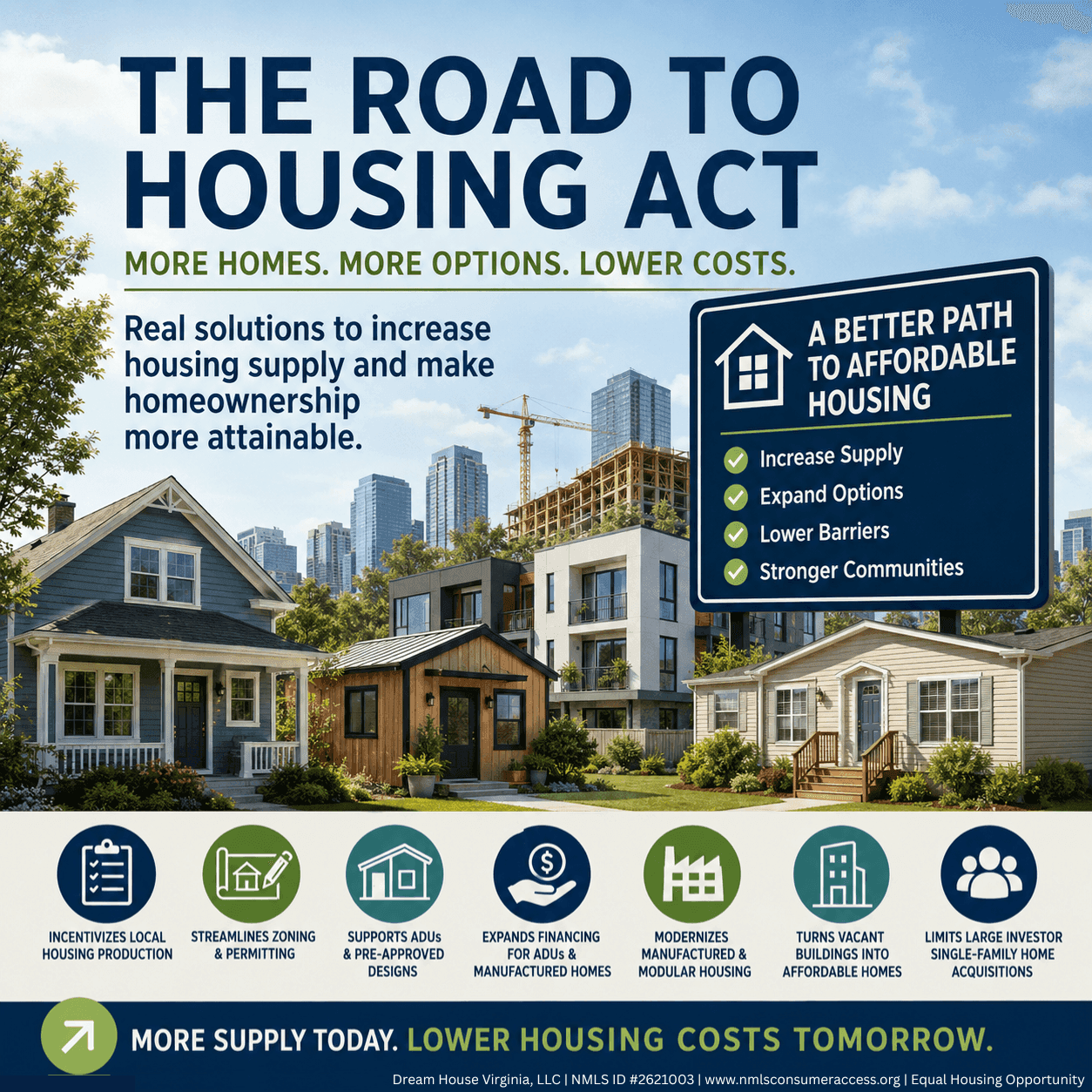
The ROAD to Housing Act is best understood as a pressure-release bill.
It tries to lower housing costs by attacking the things that keep supply tight:
For borrowers, the practical takeaway is simple: this bill may help create more options over time, but preparation still matters right now. Know your budget, understand your financing, and stay flexible about the types of homes that could work.
For Realtors, this is a chance to talk with clients about the market in a more useful way. Affordability is not only about waiting for rates to move. It is also about inventory, financing access, property flexibility, and local housing policy.
The best version of this bill will not be measured by headlines. It will be measured by whether more homes actually get built, financed, repaired, converted, and made available to real people.
That is the piece worth watching.
Because more housing options can mean less pressure.
Less pressure can mean calmer decisions.
And calmer decisions are exactly what this market has been needing.
